

We’re only days out from the start of the season meaning it’s time for my yearly preview article! For those that are new here: every season I use a model I created to predict the standings for the ECAC. Then, I go through those predictions and preview every team, giving my own commentary and opinions. I did an evaluation of the model’s performance last year recently, linked below.

Model Explanation
In the past, I’ve been asked for more details on how the model works, so I figured that’s a good way to start this preview. There are two parts of the model, offense and defense, used to project goals per game and goals against per game. It’s actually a pretty simple model overall.
On offense, every player has a projected points per game number. This is created by taking each returner’s points per game from the season prior and factoring in some projected progression based on the article I wrote below as a follow-up to my evaluation of last season.

After doing the returners, I project the incoming freshmen. I created a projection model for incoming freshmen based on their junior league and scoring rates awhile ago, but as I said in my evaluation article, I found that it has drifted more and more over time. This offseason, I recalibrated it, and I included the CHL leagues now that we have a season of data for them. Lastly, for incoming transfers, they are split into two buckets. The first is if they barely played at their previous stop. If that happens, that data is pretty much useless, and I just pretend they are a freshman and use their junior hockey scoring. If they did play though, I treat them as if they are a normal returner, and I will include an adjustment based on the conference. For example, Hockey East is better than the ECAC, so I will slightly adjust their projected scoring to be higher to factor that in. Without getting into the nitty gritty of it, I have found those projections to be pretty accurate over the years.
Once every player has a projected points per game, I create a projected lineup with the highest projections, and then I convert that lineup into a projected goals per game for the team.
The defense is a little bit more complicated. First, in net, it’s really tough to get it right, and I’ve found that’s been the hardest part to model. Usually, the model misses come from getting the goaltending wrong. For returners, we project their performance using up to 3 years of data, weighted by recency. Newcomers work the same way as it does offensively. Freshmen have a projection model based on junior hockey performance. Transfers get treated as freshmen if they barely played. Otherwise, their college hockey data is used and adjusted for conference.
After the goaltending, I try to project the quality of the defense by using returning players’ defensive impacts. I use +/- compared to the team’s average to try to model defensive impact, and then, the defensive quality is weighted by who is returning and their individual impacts. I’d honestly love to use better metrics than +/-, but that data isn’t publicly available.
With those calculated, the model generates the projected goals against per game for the team. Then, I just sort the teams by their projected overall goal differential!
1. Quinnipiac (Last Year: 1)
This year’s Quinnipiac team is the best team the model has ever seen, and it’s not close. Honestly, I have no idea how they are not getting more hype nationally because they would be on my shortlist of teams to win the national championship this year. The offensive projection is the highest the model has ever put out based on the returning and incoming talent, and the defense should be improved after the changes Quinnipiac made in net.
Key Losses: D Will Gilson (28 points in 37 games), F Jeremy Wilmer (13 points in 15 games), D Charlie Leddy (7 points in 29 games)
Key Returners: F Ethan Wyttenbach (59 points in 40 games), F Antonin Verreault (40 points in 40 games), F Markus Vidicek (35 points in 40 games), F Mason Marcellus (34 points in 38 games), F Chris Pelosi (34 points in 35 games), F Aaron Schwartz (29 points in 39 games), F Andon Cerbone (22 points in 40 games), D Elliott Groenewold (20 points in 40 games), D Braden Blace (20 points in 33 games), F Matthew Lansing (18 points in 40 games), D Graham Sward (16 points in 40 games), F Tyler Borgula (14 points in 29 games)
Key Newcomers: D Parker Alcos (WHL), G Rorke Applebee (Lake State), F Dylan Edwards (OHL), F Gabriel Frasca (OHL), D Jan Golicic (QMJHL), G Christian Kirsch (OHL), F Alex Kostov (OHL), F Jack Stockfish (Holy Cross), D Andrew Strathmann (North Dakota)
Offense
Returning Offense Rank: 1
Recruiting
Overall
Total Rank: 3
Average Rank: 1
Freshmen
Total Rank: 3
Average Rank: 1
Transfer
Total Rank: 3 (out of 9)
Average Rank: 2 (out of 9)
Overall
Forwards Rank: 1
Defensemen Rank: 3
Total Offensive Rank: 1
I have never seen a key returners list be so long in my time doing these, and that’s what propels Quinnipiac’s projected offense up to such high levels. The only key players that they are losing offensively are Will Gilson on the blue line and Jeremy Wilmer, who missed most of the season anyways.
First, Quinnipiac returns their 7 highest scoring forwards who all had at least 20 points. Ethan Wyttenbach is back after leading the nation in points as just an 18 year old and should be a dominant force in college hockey this year. Pelosi and Vidicek give them a dynamic 1-2 punch at center, while Verreault, Schwartz, Marcellus, and Cerbone add skill on the wings. Lansing and Borgula would be in the top 6 for most teams in the league, but on Quinnipiac, they might be relegated to the 4th line.
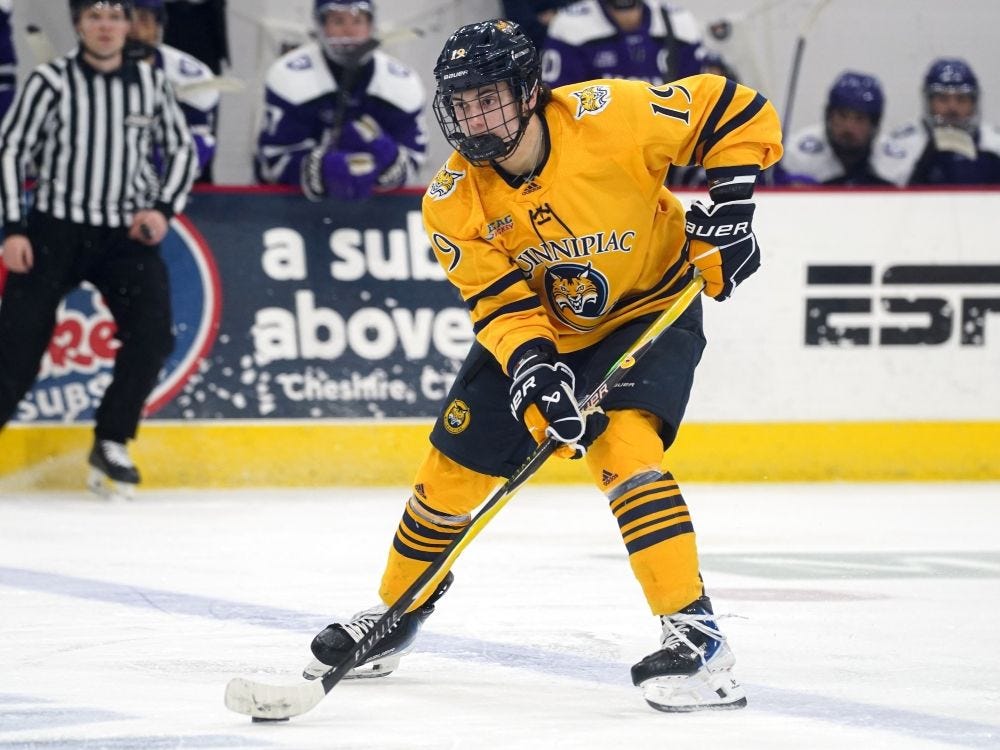
That’s just returning forwards too. The recruiting class is once again the best in the ECAC by average quality with numerous players who project to make big impacts.
Starting with the freshmen, Dylan Edwards was 9th in the OHL in scoring last season with 87 points. Alex Kostov got drafted after being passed over in the previous 2 drafts after he had 55 points in only 47 games. Lastly, Gabriel Frasca had 54 points in the OHL. Those 3 are all capable of varying levels of immediate contributions, but it’s unclear where they will fit in the lineup with all the returning talent.
Jack Stockfish is also coming in from Holy Cross after a 35 point season. He’s an outstanding 2 way center with size, and will no doubt slot into the lineup. Like the others though, it’s hard to know exactly where he will fall in such a loaded lineup.
On the blue line, Groenewold returns as the best all-around defenseman in the ECAC after putting up 20 points in 40 games and an insane +39 rating. Sward had 16 points and will return in a key role in the top 4. Blace had 20 points in limited time on the 3rd pairing.
For the newcomers, Andrew Strathmann saw limited ice time at North Dakota, but he is a very talented NHL draft pick who was outstanding in the USHL prior to college. Parker Alcos and Jan Golicic are two other NHL draft picks coming in from the WHL and QMJHL, respectively. Both have great size but can also move the puck well. They should be pretty good right away.
I know I just listed a ton of players without going super in-depth on them individually. Quinnipiac just has so much talent that I can’t go in-depth on the individual players without making this insanely long. To put into context how the model views them, it predicts they will score 5 goals per game. Obviously, that will not happen, but this is still easily one of the best forward groups in the country with starpower and depth throughout the lineup.
Defense
Projected Defensive Rank: 3
Quinnipiac is also expected to be elite defensively. They are ranked 3rd by the model for defense, but teams 1-3 are all super close together in the defensive projections. There’s not really a meaningful difference there.
Quinnipiac did lose 4 defensemen, but the model is not really concerned about those losses. Logan McCutcheon and Drew Hockley both barely played, and Gilson’s defensive impacts weren’t good last year. His impact was pretty much entirely offensive. The only key loss defensively was Charlie Leddy. He was a very good defensively minded defenseman, but since the other 3 don’t rate as big losses here, Quinnipiac shouldn’t miss a beat playing their usual system.
In the net, there was a ton of turnover, which was likely by choice after both goalies struggled last season. Matej Marinov had been rock solid in each of his first two seasons, but he fell back to a 0.898 SV%. Dylan Silverstein had numbers that looked good with a 0.912 SV%, but given the strength of Quinnipiac’s defense and how few chances they allow, it’s not actually that good.
Both goalies left in the offseason. To replace them, Quinnipiac got Rorke Applebee from the transfer portal after two great seasons at Lake State. He had a 0.907 SV% as a freshman and a 0.914 SV% as a sophomore, and considering how leaky Lake State’s defense was, these are both very good seasons. Last season, CHN had him ranked 14th in the country in goals saved above expected with 10.6 GSAx. I think he will be the primary starter in net.
The other goalie coming in is Christian Kirsch from the OHL. He had a solid season for Kitchener last year and helped lead them to the Memorial Cup. He should compete with Applebee for the starting role, but he’s a little bit raw. With Applebee being proven at the college level, he probably has the edge. Both of them should be pretty solid though, and that upgraded goaltending should have Quinnipiac’s defense back with the elite in the country.
There are literally zero question marks surrounding this Quinnipiac roster. They return a ton of talent and brought in a lot of talent to supplement it. One of their only weaknesses last season was a lack of size, and the players they brought in really help address that. Defensively, they lost very little, and they brought in even more talent than they were losing on the blue line. They upgraded in net, which was the biggest weakness last season and shores up the most important position. This is the clear #1 team in the ECAC and will be among the best teams in the country. They have a real chance at a national championship.
2. Dartmouth (Last Year: 2)
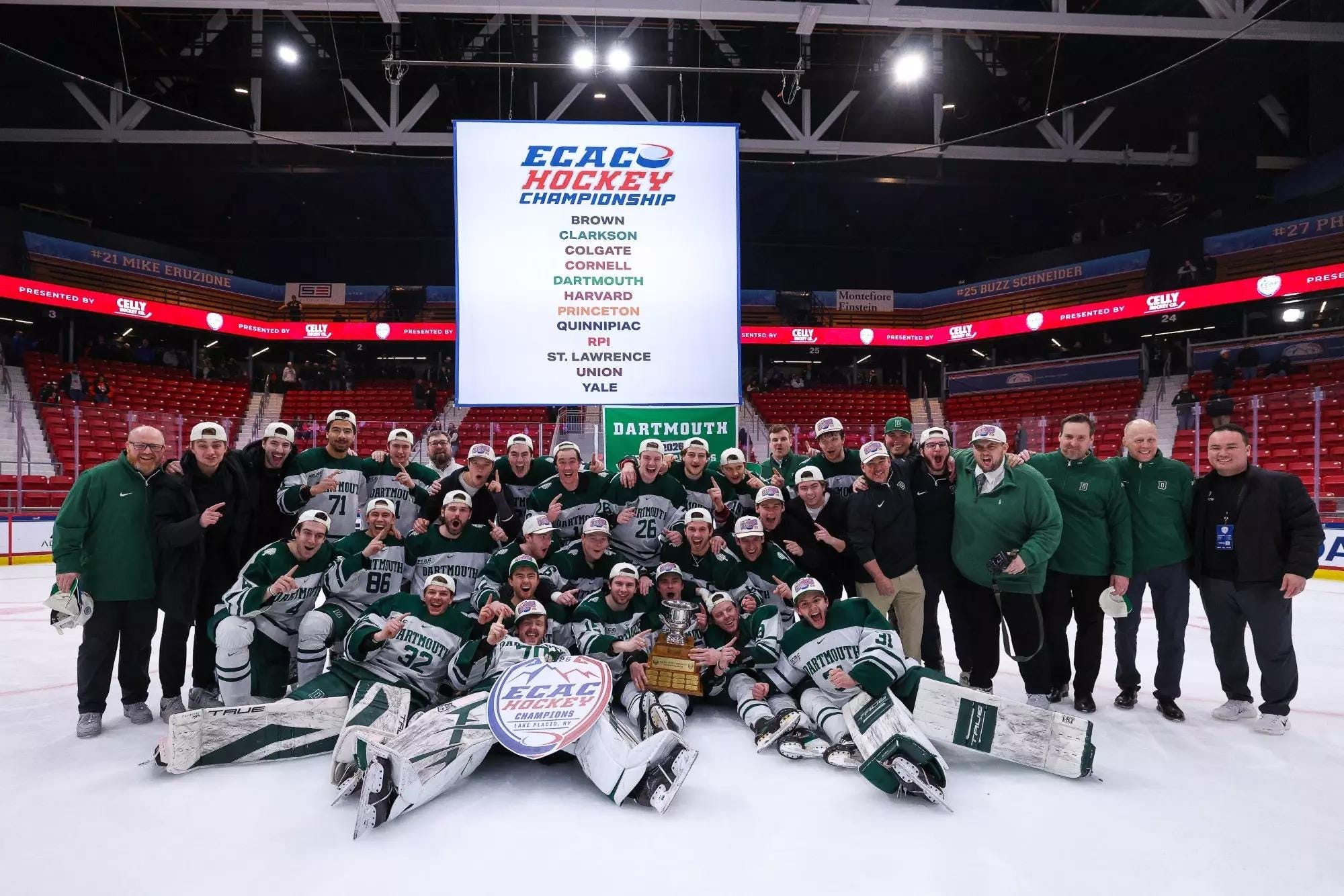
Dartmouth had a breakout year last season with their first NCAA tournament appearance since 1980 and an ECAC championship. They ended up as the #6 overall seed in the NCAA tournament but lost in the first round to Wisconsin. This year, they return basically their entire roster, and they should be a lock for the NCAA tournament as a result.
Key Losses: F Cam MacDonald (22 points in 34 games)
Key Returners: F Hayden Stavroff (48 points in 35 games), F Hank Cleaves (40 points in 35 games), F Nikita Nikora (25 points in 35 games), D CJ Foley (24 points in 35 games), D Colin Grable (20 points in 35 games), F Jack Silverberg (16 points in 35 games), F Nathan Morin (15 points in 29 games), D Eric Charpentier (13 points in 35 games), D Tim Busconi (12 points in 35 games), F Jason Stefanek (12 points in 26 games), D Cooper Cleaves (10 points in 30 games), G Emmett Croteau (0.922 SV%)
Key Newcomers: F Jesse Allecia (QMJHL), D Matthew Desiderio (Brown), G Sebastian Gatto (OHL), D Ryan Harvey (BCHL), F Drew Stewart (USHL), F Grant Young (USHL)
Offense
Returning Offense Rank: 2
Recruiting
Overall
Total Rank: 7
Average Rank: 5
Freshmen
Total Rank: 6
Average Rank: 4
Transfer
Total Rank: 9 (out of 9)
Average Rank: 4 (out of 9)
Overall
Forwards Rank: 2
Defensemen Rank: 1
Total Offensive Rank: 2
Dartmouth returns a ton of talent this season, which will make them a formidable team in the national landscape. The only key player leaving is Cam MacDonald after graduating, but I think Dartmouth did more than enough to replace him.
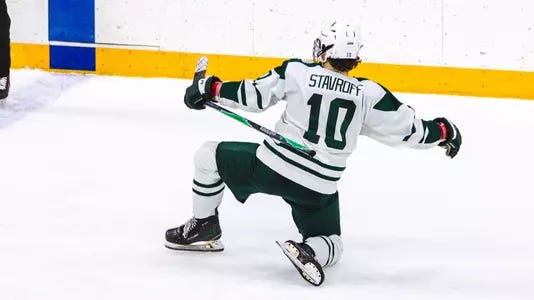
Starting off with the returning ECAC Player of the Year, Hayden Stavroff scored 29 goals last season to lead the country and turned down NHL offers to return for his junior year. He will once again be one of the top players in the country and a dynamic goal scorer. Hank Cleaves is Stavroff’s center with great size, two-way play, and passing ability. He had 40 points last season, and he returns as the second part of Dartmouth’s dynamic duo at the top of the lineup. Outside of those top two, Nikita Nikora returns for his senior year with a proven track record of scoring after 3 seasons of 20+ points.
One of Dartmouth’s weaknesses last season was a lack of scoring depth beyond those top 3 scorers, but I think that won’t be a weakness this year with all the young players returning in those depth roles who should take steps forward. Jack Silverberg and Nathan Morin had 16 and 15 points, respectively, last season, and this season, they should be able to take steps forward more in the 20 point range. Jason Stefanek could also be in that range. He only had 12 points last season but missed a decent chunk of time due to injury. Andrew Clarke, Ryan Schelling, and Brock Cummings had 12, 11, and 11 points, respectively, as freshmen last season, and they all can take steps forward to give Dartmouth more scoring depth. All of the players mentioned in this paragraph were either freshmen or sophomores last season, which is why they are all expected to take steps up to help augment Dartmouth’s scoring depth.
For the newcomers, there’s a few that should provide immediate impacts. Jesse Allecia had about a point per game in the Q last season, and he’s capable of playing in the middle 6 right away if he can earn a role over all those returning players. Grant Young had 28 points in 43 games in the USHL last season, and he should contribute in the bottom 6 right away.
The most important incoming forward though is Drew Stewart. He had over a point per game for Muskegon in the USHL last season as one of their top centers, and I think he’s capable of immediately sliding into Dartmouth’s top 6 behind Cleaves.
On the blue line, Dartmouth returns all the key players from last year’s run. CJ Foley returns as one of the top defensemen in the ECAC with a track record of producing well and winning his minutes. Eric Charpentier is one of the best shutdown defensemen in the league and has a little bit of offense to go with it too. Colin Grable had a huge breakout year last year, coming out of nowhere to score 20 points and a crazy +30 rating. Those 3 will all return to the top 4.
Outside of them, Tim Busconi and Cooper Cleaves were very good further down the lineup. Cleaves is the brother of top line center, Hank Cleaves, and his size, youth, and ability led to him being selected in the 3rd round of the NHL draft despite playing down the lineup. Busconi is a solid two-way defenseman who scored the game winning goal in OT to win the ECAC championship.
I think they will probably be the bottom pairing because Dartmouth’s only transfer portal addition is Matthew Desiderio coming over from Brown after their coaching change. He had a pretty solid freshman year there and has a great track record from his play in the USHL. I think he’ll slot in as the final defenseman in the top 4.
It’s a pretty loaded blue line with all the really good returners plus Desiderio coming in, and the model actually rates it as the best in the ECAC above Quinnipiac. It’s not more talented than Quinnipiac, but it’s older and more proven.
Offensively, Dartmouth is pretty loaded up all around to make another run this year. They return tons of top end talent and depth throughout the lineup, which will only continue to develop, and their incoming class has a few players who should be key contributors right away.
Defense
Projected Defensive Rank: 1
Dartmouth will be one of the best defensive teams in the country this year, much like last year. They have the best returning blue line in the league, which should at minimum maintain their elite level of chance suppression and shot suppression, but it’s certainly possible that it improves too. Returning all top 6 defensemen and then adding a top 4 defenseman from another ECAC team will do that!
Then, in net, Dartmouth will be totally set. Emmett Croteau finally broke out with a 0.922 SV% and returns for his senior year where he will be locked in as the #1 goaltender. He ranked 16th in the country in goals saved above expected with 8.11.
Should he falter for any reason though, I love incoming freshman Sebastian Gatto. He had a 0.916 SV% with London in the OHL last season, which was good for 5th in the league. London is also one of the best programs in the entire CHL, which only gives more confidence in his abilities. I think he is actually capable of pushing Croteau right away, but it’ll be Croteau’s net to start and presumably throughout the year. Gatto is great insurance behind him though, and he will take the mantle up in the future.
Overall, Dartmouth is projected to be an NCAA tournament lock by the model, and it actually has them rated so highly that I think they are a darkhorse national championship contender. I wouldn’t put them in my top 5 contenders or anything, but they have the ability to be in the mix. The only real question mark is if their depth scoring can improve this year through the development of the young players and newcomers. It’s worth noting that Dartmouth had a 12.8% shooting percentage last year too, which was 2nd in the country, and it’s possible that falls down too. That’s been consistent for Dartmouth under Cashman though, so I think that’s just them prioritizing quality over quantity at a system level. Regardless, it would take a disaster for them to miss the tournament, and if they can play up to their potential, the rest of the country should watch out.
3. Cornell (Last Year: 3)
Cornell had a really good season last year, reaching 11th in the NPI, but got blown out by Denver in round 1 of the NCAA tournament. The model views them very highly with all the talent coming back, but there is one major question mark remaining. They should be an NCAA tournament lock either way, but it’ll determine their ceiling this season.
Key Losses: F Jonathan Castagna (34 points in 34 games), D Hoyt Stanley (15 points in 34 games), G Alexis Cournoyer (0.915 SV%)
Key Returners: F Ryan Walsh (33 points in 33 games), F Caton Ryan (30 points in 34 games), F Charlie Major (27 points in 32 games), D Xavier Veilleux (26 points in 34 games), D George Fegaras (21 points in 34 games), F Aiden Long (20 points in 34 games), F Jake Kraft (18 points in 34 games), D Luke Ashton (11 points in 34 games), D Michael Fisher (8 points in 33 games)
Key Newcomers: F Charles Arend (USHL), F Coco Armstrong (WHL), F Brad Gardiner (OHL), D Ryland Randle (USHL), G Mathis Rousseau (Maine), F Ivan Zadvernyuk (Brown)
Offense
Returning Offense Rank: 3
Recruiting
Overall
Total Rank: 4
Average Rank: 4
Freshmen
Total Rank: 4
Average Rank: 5
Transfer
Total Rank: 8 (out of 9)
Average Rank: 1 (out of 9)
Overall
Forwards Rank: 3
Defensemen Rank: 4
Total Offensive Rank: 3
While Cornell did lose Castagna early to an NHL contract, he was the only important loss up front, and they did well to replace him as best they could.
Still, they return Ryan Walsh for his second year as the captain, and he will once again be one of the top forwards in the ECAC and slot in as the top line center. Caton Ryan also returns after an outstanding freshman year with 30 points, and with his youth, he should have a good step forward too. Charlie Major returns after his 27 point campaign last season too, and those three should make up a dynamic trio on the top line.
The other key forwards returning are Aiden Long and Jake Kraft. Long had a pretty good 20 point freshman season and should slot right into the top 6 at LW. Kraft is a proven, steady middle 6 player who can provide good depth scoring. It’s also possible Gio DiGiulian takes a step forward after putting up 14 points and 9 goals as a freshman last season.
For the newcomers, Ivan Zadvernyuk is transferring from Brown, and he is the replacement for Castagna at center. He had 22 points in 30 games for Brown last year and is a skilled center with great size. He should fill that void as the second line center behind Walsh, although his penchant for taking really dumb penalties could get him in trouble with such a disciplined program. Brad Gardiner is the highest projected freshman after a 65 point OHL season. He’s capable of sliding right into the top 6, but with Cornell’s talent and depth, he might be on the third line to start. Charles Arend had a great USHL season, but he probably starts in the bottom 6 due to Cornell’s depth. Same with Coco Armstrong after his WHL season.
The forward group for Cornell looks very good because Walsh, Ryan, Major, and Zadvernyuk give them a lot of top end talent, and they also should have the necessary depth between Long, Kraft, DiGiulian, Gardiner, Arend, and Armstrong.
On the blue line, Veilleux returns after an outstanding 26 point freshman season. He was immediately one of the best defensemen in the ECAC and played 24 minutes a night, and he should only keep getting better and better with how young he is. George Fegaras has had very good career for Cornell so far, and he returns for his senior year where he’ll likely be the #2 to Veilleux after 21 points last season. Luke Ashton is more of a defensively minded defenseman, but he has some offensive upside too. I think he will build on his 11 points from last year with more ice time and continued development.
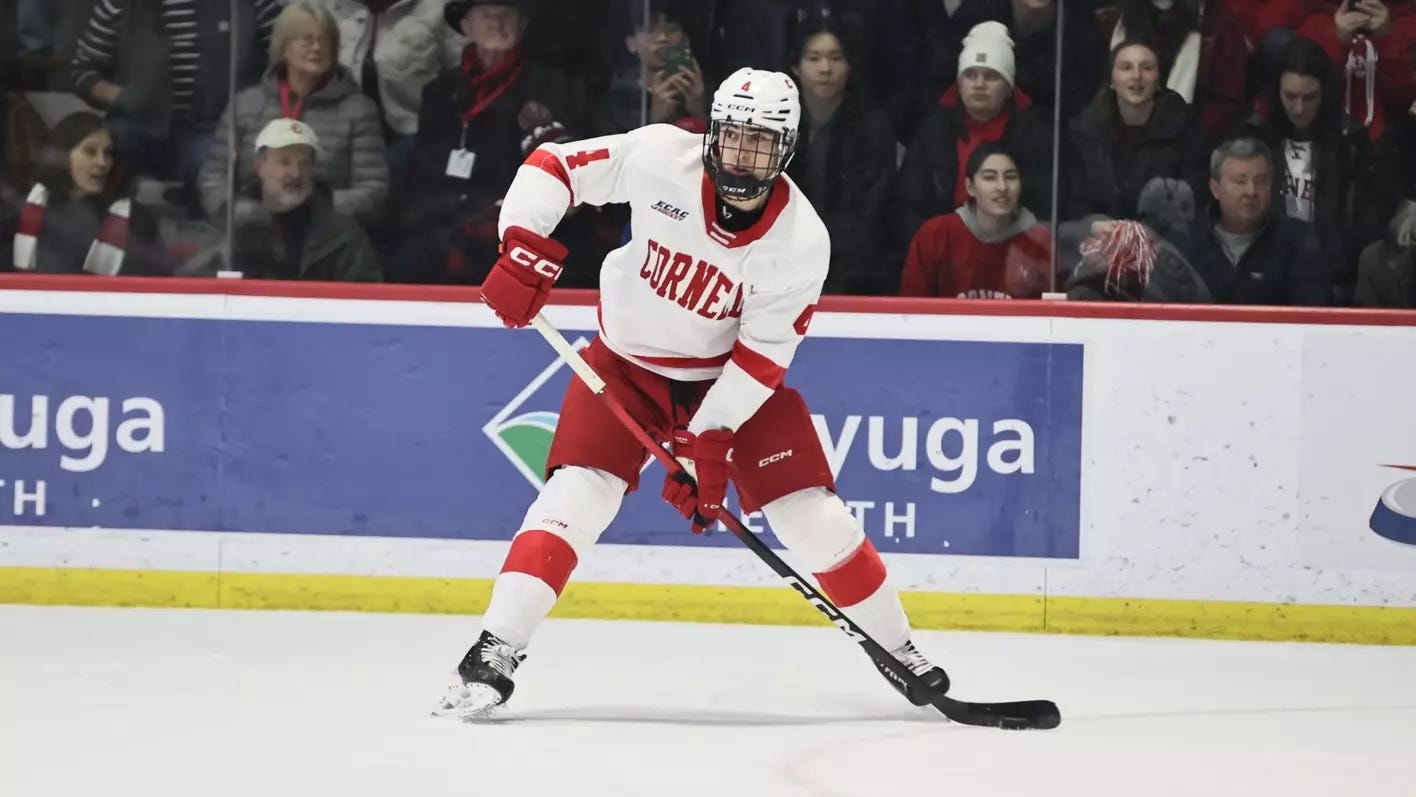
There’s only two incoming defensemen, both freshmen, but they both expect to slot into the lineup. Ryland Randle had a great year in the USHL, and while he doesn’t have the size of typical Cornell defenseman, he’s a really good player who gives their blue line a bit of a different look. Cole Tuminaro doesn’t have much offense to his game, but he will find his way into the lineup given his size and defensive abilities that led to him being drafted.
Despite the loss of Castagna and Stanley, Cornell has enough firepower in the lineup to again make the NCAA tournament. I actually think the lineup all-around is better than last year’s, and it’s pretty comparable to Dartmouth in terms of the model’s projection. They should have no issues scoring this year.
Defense
Projected Defensive Rank: 2
Cornell’s defensive structure pretty much always guarantees that they will be a top team defensively, regardless of the personnel. That remains true for this upcoming season, but there are still plenty of reasons to like them outside of that.
The only key loss on the blue line is Hoyt Stanley, but the model doesn’t view it as that big a loss defensively. While he played a ton of minutes last season, his defensive impacts in terms of +/- were not that good. The other regular they lost was Jack O’Brien who was solid on the 3rd pairing but very replaceable. The rest of the defensemen return, which includes 3 of the top 4, as I mentioned in the offense section, and that will keep the quality of their defense high.
The real issue and biggest question mark for Cornell is in net. They lost Alexis Cournoyer to the transfer portal after a great freshman year with a 0.915 SV%. Cornell went out into the portal and got Mathis Rousseau from Maine to replace him. The model does not have much faith in him, and to be honest, I’m not sure I do either. Last season, he had a 0.896 SV% despite playing for a Maine team that was pretty strong defensively. His goals saved above expected was -4.54 on the season, which ranked 130th in the country. I also am not sold on his track record prior to Maine. He played in the QMJHL for a long time, and his numbers his final year there were just okay with a 0.906 SV% and a 0.903 SV% split between two teams. While his numbers were better prior, he was on one of the best QMJHL teams those years, and he’s undersized to boot.
The two backups who are returning are Justin Katz and Erick Roest, and both have not seen a single minute of NCAA action. If Rousseau falters, there is no backup plan. A counterargument is that you could argue that Cournoyer wasn’t even that good when you factor in the quality of Cornell’s defense. Despite a 0.915 SV%, he only had 1.02 goals saved above expected, which was 51st in the country. If Rousseau can give them even average goaltending, he likely will have pretty solid numbers, and that should be good enough with the quality of the defense.
The goaltending question mark is what keeps Cornell below Dartmouth in the rankings even though they are quite close. If Rousseau can be that guy for them, they could surpass Dartmouth to get 2nd. Overall, he will determine their ceiling. The model likes Cornell so much that if he gives them good goaltending, they could be a darkhorse national championship contender. As it stands right now though, they’re rated a tournament lock with the talent and defense they have as long as he’s not disastrous. Can they be more than that? It’ll be something to watch.
4. Union (Last Year: 5)
Union was pretty good last season, rising up to 26th in the NPI, and they were in contention for a first round bye the entire year but fell just short to Princeton. Their puck possession system was very good, and they had a lot of offensive firepower. However, this is the first ranking that I disagree with the model. Union lost a lot of talent in the offseason, but they’re still rated highly because they return a ton of depth scoring. The returning scoring is rated too highly in my opinion because Union beat up on a weak non-conference schedule and inflated their offensive numbers, and they didn’t play nearly to that level in conference play. They should still be pretty solid, but I’d personally have them a little lower.
Key Losses: F Ben Muthersbaugh (36 points in 36 games), F Brandon Buhr (36 points in 35 games), F Parker Lindauer (34 points in 37 games), F Colby MacArthur (32 points in 35 games), F Nate Hanley (22 points in 36 games)
Key Returners: D Tyler Dunbar (33 points in 37 games), F Lucas Buzziol (27 points in 37 games), D Etienne Lessard (24 points in 37 games), F Alex Laurenza (19 points in 32 games), F Riley Brueck (17 points in 36 games), D Will Felicio (13 points in 33 games)
Key Newcomers: F Tommy Cronin (Alaska), F August Falloon (Minnesota), F Nathan Free (WHL), F Gavin Garry (USHL), F Luke Garry (USHL), F Elliot Gulley (USHL), F Lefty Markonidis (USHL)
Offense
Returning Offense Rank: 6
Recruiting
Overall
Total Rank: 2
Average Rank: 3
Freshmen
Total Rank: 2
Average Rank: 3
Transfer
Total Rank: 1 (out of 9)
Average Rank: 3 (out of 9)
Overall
Forwards Rank: 4
Defensemen Rank: 2
Total Offensive Rank: 4
From the list of key losses and key returners, it should be obvious why I’m skeptical of the model. Union loses its top 3 scorers and 4 out of their top 5 with only Tyler Dunbar returning from that group. For the forwards, they lose 5 out of their top 6 with only Lucas Buzziol returning.
That being said they do have some talent returning. Buzziol had 27 points last season. Alex Laurenza had a solid freshman year with 19 points. Riley Brueck had 17 points and should be able to take a step with more ice time. Connor Smith had 12 points in only 30 games and will likely be a lineup regular this year. Drew Sutton, Troy Pelton, and Jacob Jeannette all had decent results in very limited ice time.
For the newcomers, it is a pretty good recruiting class overall between the transfers and freshmen. The Garry twins both had about a point per game in the USHL last season and should play key roles immediately. Elliot Gulley had 51 points in the USHL, and Nathan Free had 53 points in the WHL; both should slot into the lineup right away. Tommy Cronin transferred in from Alaska after 16 points in 18 games as a freshman. August Falloon barely played at Minnesota, but he was solid in his final USHL season before going there.
That’s a good amount of talent coming in, and that talent combined with the returners that Union does have is why the model still likes the forward group. I want to go a little deeper though to explain why I’m skeptical of it.
First, as I mentioned before, Union played an extremely weak non-conference schedule that really inflated their numbers. Their scores were:
1-1 vs Army
5-2 at Mercyhurst
5-3 at Mercyhurst
3-2 vs Niagara
6-0 vs Niagara
7-1 vs Lowell
6-0 vs UNH
8-1 vs Sacred Heart
2-3 vs Miami
5-1 vs Alaska
3-2 vs Alaska
5-4 vs RPI
That works out to 4.67 goals per game. In conference play, they averaged 3.23 goals per game. That’s a huge difference, and it got reflected in the stats for their players too.
For the returners I mentioned, Buzziol only had 14 points in conference play, Laurenza had 10, Brueck had 8, and Smith had 3. All of these players at least put up half their production against the weak competition in non-conference play. This also applies to the defensemen too. Tyler Dunbar only had 15 points in ECAC play, and Etienne Lessard only had 12.
Second, based on the projections, two of the three players on their top line are projected to be Laurenza and Tommy Cronin, and I have questions about them outside of the schedule strength last year. For Laurenza, he was a healthy scratch at times last year despite his ability to put up points, and only 4/19 points were goals. If the staff didn’t have full belief in him last year, and he can’t really score goals for a team that lost all its best goal scorers, why should I think he can make that jump? For Cronin, he only played 18 games due to injury, so it’s possible that his scoring would have regressed with a full season of play. Even if not, he also only had 4 goals out of his 16 points, and his track record before Alaska wasn’t good. In his final year of junior hockey, he was not able to hold down a spot in neither the USHL nor BCHL and ended up back in the NAHL. I don’t believe he’s a top line player like the model is projecting based on his limited time at Alaska.
To be clear, I don’t think Union will be bad offensively, and they should still be pretty solid. I just think the model is overrating the offense and team in general with all of this.
Defense
Projected Defensive Rank: 5
Union had a solid defense last year, and it should be solid this year as well. They return 5 out of their top 6 defensemen, and Nick Young doesn’t register as that big of a loss. Tyler Dunbar should be their best all around player not just because of his offense, but he also has pretty good defensive impacts. Etienne Lessard had decent defensive impacts for a freshman especially considering his lack of size, while DJ Hart had good defensive impacts in limited ice time. He will look to shoulder more responsibility this season.
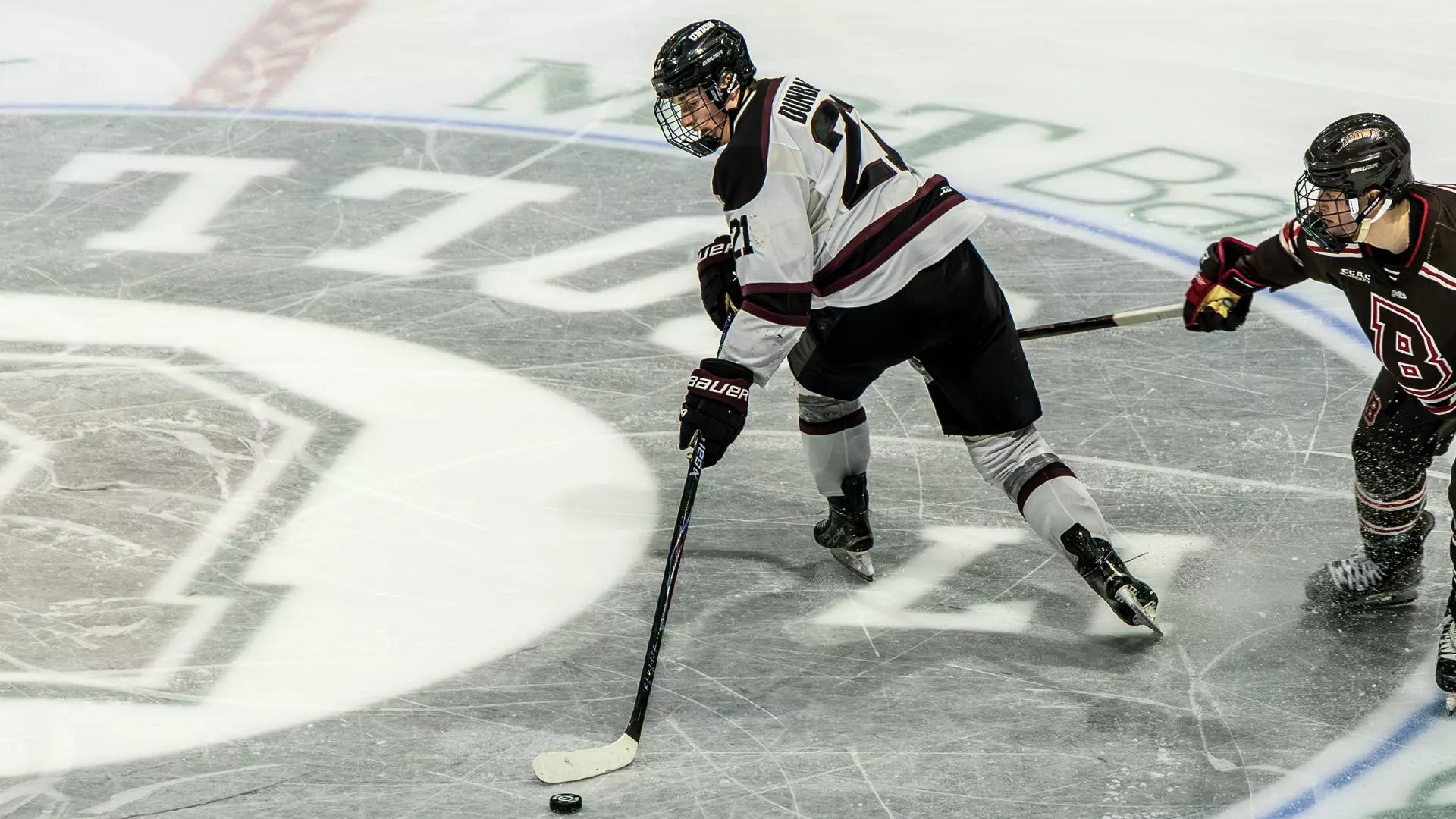
In net, Cameron Korpi returns after an underwhelming season last year with a 0.899 SV%. He had a solid freshman year at Michigan and was good in the USHL before that, so I would imagine he bounces back. If he doesn’t though, Union also returns Brayden Gillespie who had a 0.915 SV% in limited time last season behind Korpi. With his performance, I imagine that Korpi won’t have too long of a leash should he struggle out of the gate.
Overall, Union could definitely finish 4th with the talent they have on the roster. Doing that will require their key players to perform better in conference play and all the newcomers to adapt quickly. Even at their ceiling though, I can’t see them coming close to catching the top 3, and at best, they probably land at 20th in the NPI. With how the model is overrating their numbers though and only pretty small gaps between teams 4-6 in the model, I think they don’t wind up in 4th. I’d put them 5th or 6th.
5. Clarkson (Last Year: 8)
Clarkson was very inconsistent last season due to its youth. They had the talent and ability to beat anyone with wins against Penn State, North Dakota, and a sweep of Quinnipiac in the ECAC playoffs to reach Lake Placid. They also could lose to anyone though with losses to Canisius, RIT, and Alaska. After ending the year on a high note and with a lot of that young talent returning this season, they should make a move up the standings.
Key Losses: F Ryan Bottrill (36 points in 38 games), F Erik Bargholtz (20 points in 38 games), D Tristan Sarsland (16 points in 38 games), D Matthew Mayich (15 points in 34 games)
Key Returners: F Owen Van Steensel (25 points in 38 games), F Remi Gelinas (21 points in 38 games), F Jared Mangan (20 points in 38 games), F Justin Cote (19 points in 38 games), D Tate Taylor (19 points in 37 games), D Ty Brassington (16 points in 38 games), F Jace Letourneau (13 points in 26 games), F Adrian Misaljevic (4 points in 6 games)
Key Newcomers: D Michael Craig (Robert Morris), D Axel Dufresne (QMJHL), G Ben Gaudreau (ECHL), F Sebastien Gervais (OHL), F Alex Pharand (OHL), F Hayden Reid (OHL), F Tyler Wallace (RPI), D Nikolas Young (USHL)
Offense
Returning Offense Rank: 5
Recruiting
Overall
Total Rank: 5
Average Rank: 6
Freshmen
Total Rank: 7
Average Rank: 6
Transfer
Total Rank: 4 (out of 9)
Average Rank: 5 (out of 9)
Overall
Forwards Rank: 6
Defensemen Rank: 5
Total Offensive Rank: 5
Clarkson isn’t quite at the level to return to the NCAA tournament, but they will definitely be improved. The young talent returning this season is a big reason why. First, Van Steensel, Gelinas, and Cote all return after putting up 20+ points in their freshman year and should be mainstays in the top 6. Jared Mangan also had 20 points in his sophomore season and should join them in the top 6.
Outside of those 4, Luka Sukovic, Talon Sigurdson, and Jace Letourneau were all in the teens in points, and I expect all of them will slot into the lineup probably in 3rd line type of roles. Getting Adrian Misaljevic back healthy will be huge for Clarkson as well. He had 4 points in the first 6 games of the season before missing the rest of the year due to injury. If he had been healthy, he would be mentioned with the other 3 freshmen above, and I think he’s in line for a great year. On a similar note, I’m very curious where Mikael Huchette will fit in the lineup after he missed all of last season due to injury. He was pretty good in the QMJHL and USports before landing at Clarkson.
For the incoming forwards, they all project more as 3rd line or depth type of players, which is why their recruiting rankings are probably lower than you would expect. The best newcomer is Tyler Wallace coming in from RPI where he had 18 points last season. He will probably do about the same for Clarkson this season and should be somewhere in their middle 6. Gervais, Pharand, and Reid all project as pretty good bottom 6 players, and they will be competing with guys like Mael St-denis, Shawn O’Donnell, and Conyr Hellyer for spots in the lineup. Clarkson’s forward depth is excellent this season, and they have no shortage of options at the top, middle, and bottom of the lineup.
On the blue line, Clarkson does lose Tristan Sarsland who was excellent over the course of his career there, but they return Tate Taylor. Taylor will move up to the #1 role now that Sarsland has graduated, and I think he will do quite well there. Clarkson also returns Ty Brassington after he had 16 points last season.
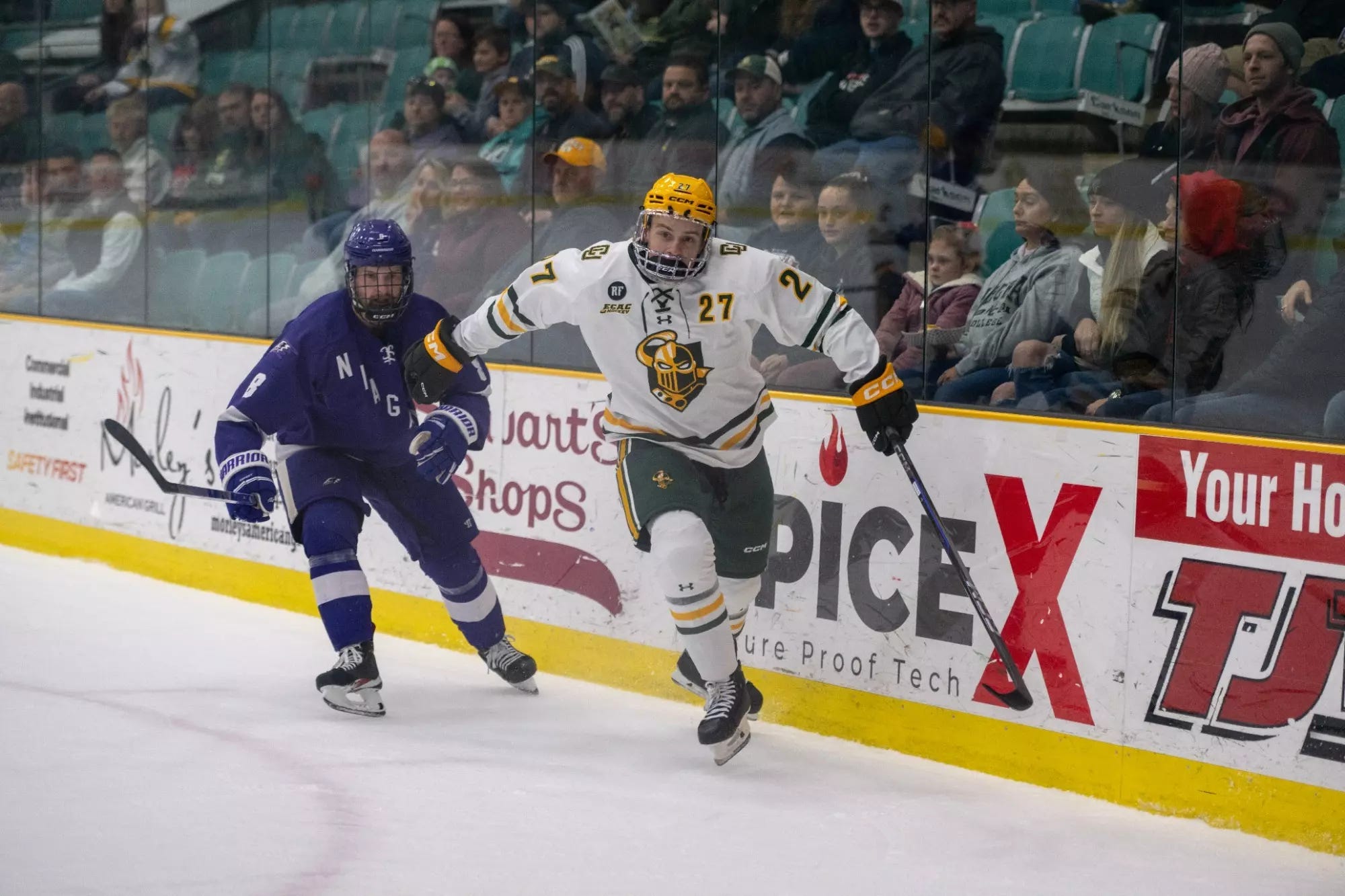
While they also lost Matthew Mayich (who everyone in the hockey community is thinking of and praying for) after an excellent freshman year when he entered the portal and went to Arizona State, Clarkson did pretty well with who they bring in, which I think will help mitigate that loss on offense. Michael Craig transferred in from Robert Morris after 3 great years there and should immediately slide into the top 4. Nikolas Young had 42 points in 61 games in the USHL last season, which is excellent for a defenseman, and I think he will make an immediate impact. Axel Dufresne comes in from the QMJHL after 4 years there, and I also expect he will make an impact right away.
I really like the makeup of this Clarkson offense. There’s talent and depth at both forward and defense, and all the key contributors coming back were younger players who should still be on an upward trajectory.
Defense
Projected Defensive Rank: 7
Defense will be the question mark with this Clarkson team. They fell from 2.23 goals against per game 2 years ago to 2.92 last year. The model is projecting them to be about the same this year overall.
The model has Mayich as a huge loss for the defense. Last season, he was the only defenseman who had a positive +/- rating, and it wasn’t very close. He had a +13 while the next highest was a -1. That discrepancy means that Clarkson is getting dinged a lot for that loss in addition to the loss of Sarsland. It honestly might be too harsh here, and I wouldn’t be surprised if it turns out to not be an issue because of the quality defensemen Clarkson has coming in. I’m just explaining why the model sees it that way.
In net, the model is not totally sold either. It doesn’t have the goaltending as bad, but it’s not rated as good either. Shane Soderwall returns as the starter, but he only had a 0.905 SV% last season, which is below average for a starting goalie. I do think he was a little better than that indicates since he saved 2.92 goals above expected for the year, which was 38th in the country. He’s definitely not bad, but Clarkson will look for him to take a step to being above average.
Behind him, I’m not really sold either. If we’re being honest, any backup they have will be better than Keenan Rancier was last year, so it’s not a big deal. However, their backup will be Ben Gaudreau coming in from the ECHL. Gaudreau has played the past 2 seasons in the ECHL with a career 0.900 SV% at that level. While that’s not bad, it’s not good either, and it doesn’t really inspire confidence that he’s more than just a reliable backup, which is what the model rates him as. Maybe it’s wrong, but the NCAA is, on average, better than the ECHL.
Overall, Clarkson should be taking a jump up the standings this year with all the talented young players returning and plenty of depth. I really like the roster on paper. If the defense and goaltending can improve, then watch out. Even without that though, I personally think they end up higher than Union and get to 4th place in the league.
6. Harvard (Last Year: 6)
As I mentioned in my piece reviewing last season, Harvard did not take the step I was expecting due to their top players all regressing. This year, it’s hard to know what to make of them. As always, they have a lot of talent and a very good recruiting class. Ted Donato stepped down though. It’s already hard to know how that talent will fare given the struggles the past few seasons, and a new head coach just makes it that much tougher. With how close 4-6 are in the model, I could see them landing anywhere in that grouping.
Key Losses: F Philip Tresca (19 points in 30 games), F Casey Severo (18 points in 34 games), D Ryan Healey (12 points in 34 games), D Mason Langenbrunner (10 points in 32 games)
Key Returners: F Mick Thompson (27 points in 33 games), D Matthew Morden (20 points in 34 games), F Heikki Ruohonen (19 points in 28 games), F Richard Gallant (18 points in 34 games), D Lucas St. Louis (11 points in 33 games), G Ben Charette (0.910 SV%)
Key Newcomers: F Niles Benson (USHL), F Justin Graf (USHL), G Rudy Guimond (QMJHL), D Alex Huang (QMJHL), F Joseph Salandra (OHL)
Offense
Returning Offense Rank: 7
Recruiting
Overall
Total Rank: 10
Average Rank: 2
Freshmen
Total Rank: 5
Average Rank: 2
Transfer
Total Rank: N/A
Average Rank: N/A
Overall
Forwards Rank: 5
Defensemen Rank: 8
Total Offensive Rank: 6
Harvard’s offense definitely has a higher ceiling than this if Rob Rassey can get the young players to progress more than they had been under Ted Donato. Mick Thompson returns as the leading scorer after a 27 point season, though he did have 32 points the year prior. Heikki Ruohonen was an excellent two way center as a freshman, and he should take a step forward this year and be Harvard’s top line center. Richard Gallant had 18 points as just an 18 year old freshman, and he should also take a step forward.
After those 3, there are some question marks at forward, but the talent is there to answer them. Ben MacDonald fell from 16 points to 10 points and battled injuries last season. If he can have a bounce back year, that would really help the offense. Harvard, on paper, is missing a second line center, and if MacDonald can fill that void, that would be huge. I also have my eyes on Michael Callow and Aidan Lane. Callow is talented, and he had a very good finish to last season after dealing with injuries most of the year. I wouldn’t be surprised if he has a breakout year. Lane is even more talented, but he was very young as an 18 year old freshman last year. He also didn’t have a full year of junior hockey before enrolling, so it was always going to take him time to get acclimated to college hockey. I’m a big believer in his skill and upside.
For the freshmen, Niles Benson and Joseph Salandra project to be bottom 6 players to start. Justin Graf is one of the best incoming freshmen in the ECAC though. He had 55 points in 52 games in the USHL last year and was selected in the 4th round of the NHL draft. I expect he will earn a top 6 spot right away.
On the blue line, Matthew Morden returns as the #1 defenseman after a breakout year with 20 points and great defense to go with it. Harvard also returns Lucas St. Louis who has proven himself to be a solid top 4 defenseman. Alex Huang is the best incoming defenseman in the league by far after his 70 point season in the Q last year. He should play big minutes on the top pairing immediately.
I think Harvard’s biggest issue this season though is the depth on the blue line. After those 3, the next best defenseman is Drake Murray. While I don’t think he’s bad, he only played in 24 games last season, and I do not think he is top 4 quality. After him, it gets even worse. Donato Bracco really struggled as a freshman last year. He has a lot of talent coming from the NTDP, but he needs to make some major strides in order to be counted on consistently in the lineup. Lastly, I’m just not a believer at all in any of Sean Keohane, Matthew Biotti, James Mackey, or David Hejduk.
The writeup should make it clear why Harvard ranks where they do offensively. They have questions around their secondary scoring at forward, and they have issues with their defense corps after the top 3. The talent is there to be better than expected in those areas though, and it’ll be up to Rassey to get that performance out of them.
Defense
Projected Defensive Rank: 6
Harvard should be solid defensively this season because of their goaltending even if their blue line is questionable. Everything I said about the defensemen in the offense section also pretty much applies here. I don’t have faith in any of the players outside of the top 3 barring Murray and Donato taking major leaps forward. This dings their defensive projection for the model.
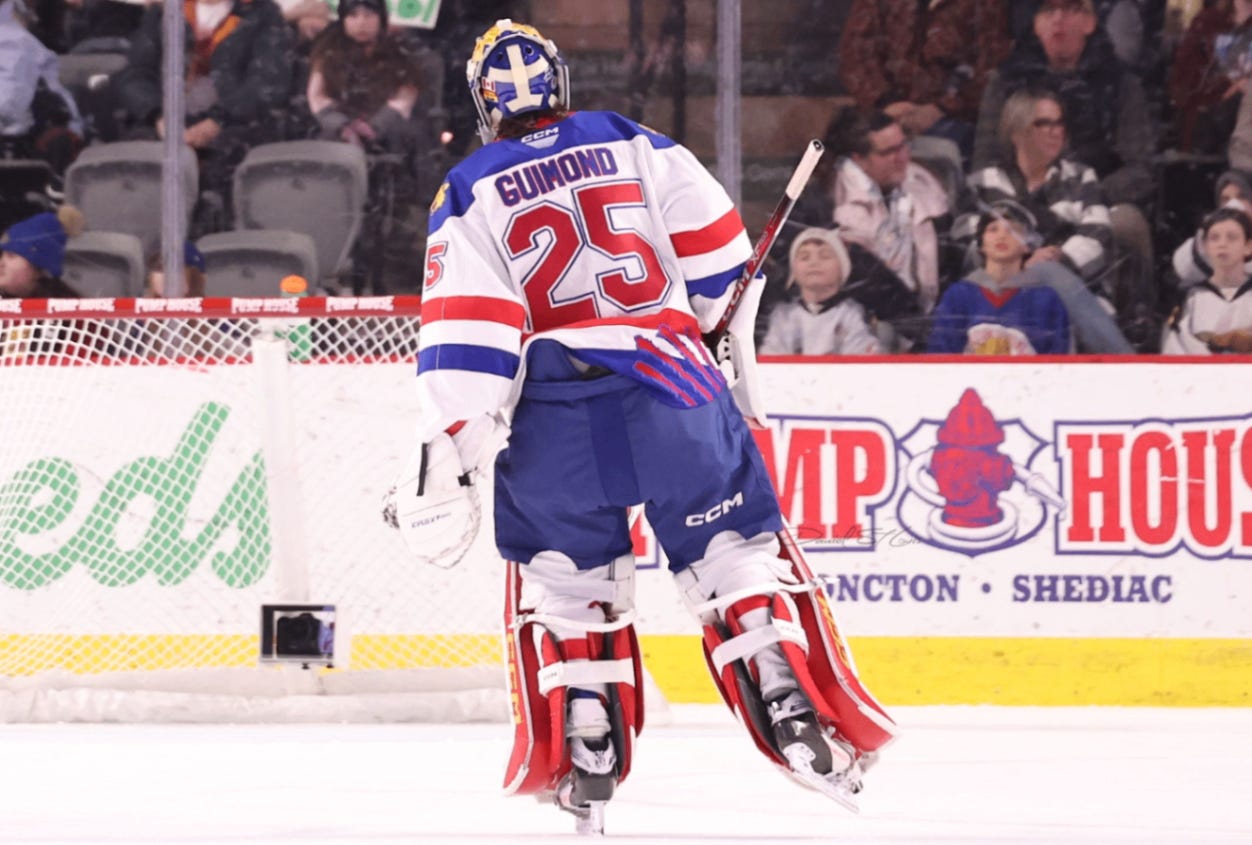
However, the goaltending should be very good for Harvard this season. Ben Charette returns after two solid seasons with a 0.909 and 0.910 SV%, respectively. He can be a solid starter if relied upon. However, I actually think he’s going to get usurped this year. Harvard is bringing in Rudy Guimond from the QMJHL where he was outstanding the past two years. Two seasons ago, he had a 0.940 SV%, and last season, he had a 0.922 SV% while playing 50 games. This was the second best save percentage in the league, and the player in first only played 14 games. Based on his track record, I think he can beat out Charette and be among the top goalies in the league right away. This projected goaltending brings Harvard’s defensive projection back up to a solid level in spite of the defensemen.
Overall, Harvard definitely has the talent to end up higher than this. With the tight grouping of teams in the 4-6 range, they could find their way into the top 4. Where they land in the standings will come down to getting development from the players in the middle and bottom of the lineup to give some quality depth.
7. Colgate (Last Year: 7)
Colgate took an expected step back last season due to a lack of talent and poor defensive structure. This year looks to be about the same middle of the pack type of season. There appears to be limited secondary scoring, and the defense seems like it’ll struggle again.
Key Losses: F Simon Labelle (28 points in 37 games), D Michael Neumeier (23 points in 37 games), D Jacob Napier (11 points in 35 games)
Key Returners: D Isaiah Norlin (28 points in 37 games), F Ryan Sullivan (26 points in 36 games), F Max Nagel (26 points in 27 games), F Jack Brandt (18 points in 34 games), D Josh Niedermayer (10 points in 27 games), D Brett Merner (7 points in 18 games)
Key Newcomers: F Braiden Clark (OHL), D Nathan Larioza (BCHL), F Tobias Ohman (USHL), F Luke Shcherbyna (WHL)
Offense
Returning Offense Rank: 8
Recruiting
Overall
Total Rank: 6
Average Rank: 9
Freshmen
Total Rank: 8
Average Rank: 8
Transfer
Total Rank: 7 (out of 9)
Average Rank: 9 (out of 9)
Overall
Forwards Rank: 9
Defensemen Rank: 6
Total Offensive Rank: 7
Colgate lost a couple of its top players, but they return enough that they should be decent offensively. They also were hurt last year with some injuries to key players, and having those players healthy will be helpful.
Simon Labelle graduated from the top of the lineup, but Max Nagel and Ryan Sullivan return after pretty good years with 26 points each. Nagel, in particular, should be excellent as he was producing at a point per game level but couldn’t play the full season due to injury.
There’s not much returning behind those two, however. Jack Brandt had 18 points, but he’s not the type of player that I see making a big step forward. Tyson Doucette and Easton Wainwright had okay freshmen years with 11 and 10 points, respectively, but they will need to take major jumps to help Colgate offensively.
There’s a trio of newcomers who look like solid pickups to varying degrees, but the issue is that they will likely be forced to play higher up in the lineup than they should be. Tobias Ohman is the best incoming player after he had nearly a point per game in the USHL last year. He’s a shifty and skilled player with the puck. However, I have questions about how his game will translate. He is absolutely tiny, and he could get pushed around in a physical league like the ECAC. The other two project as 3rd line type players. Braiden Clark left Providence and played for London in the OHL last year where he was just okay. He definitely has some talent, but his scoring track record the past couple of years has not been there. Luke Shcherbyna comes from the WHL where he had a good but not great year.
This lack of depth really hurts Colgate offensively, but they are helped a lot by having some capable puck movers on the back end, even after the departure of Michael Neumeier and Jacob Napier. Isaiah Norlin returns after he had 28 points in 37 games. He should make an All-ECAC team again this season. Josh Niedermayer is also back and should have an expanded role. He had 10 points in 27 games with 3rd pairing minutes. With top 4 minutes, I expect he’ll put up even more points. Having Brett Merner back healthy will be helpful too. He was on his way to a solid season last year, but he missed half the year due to injury.
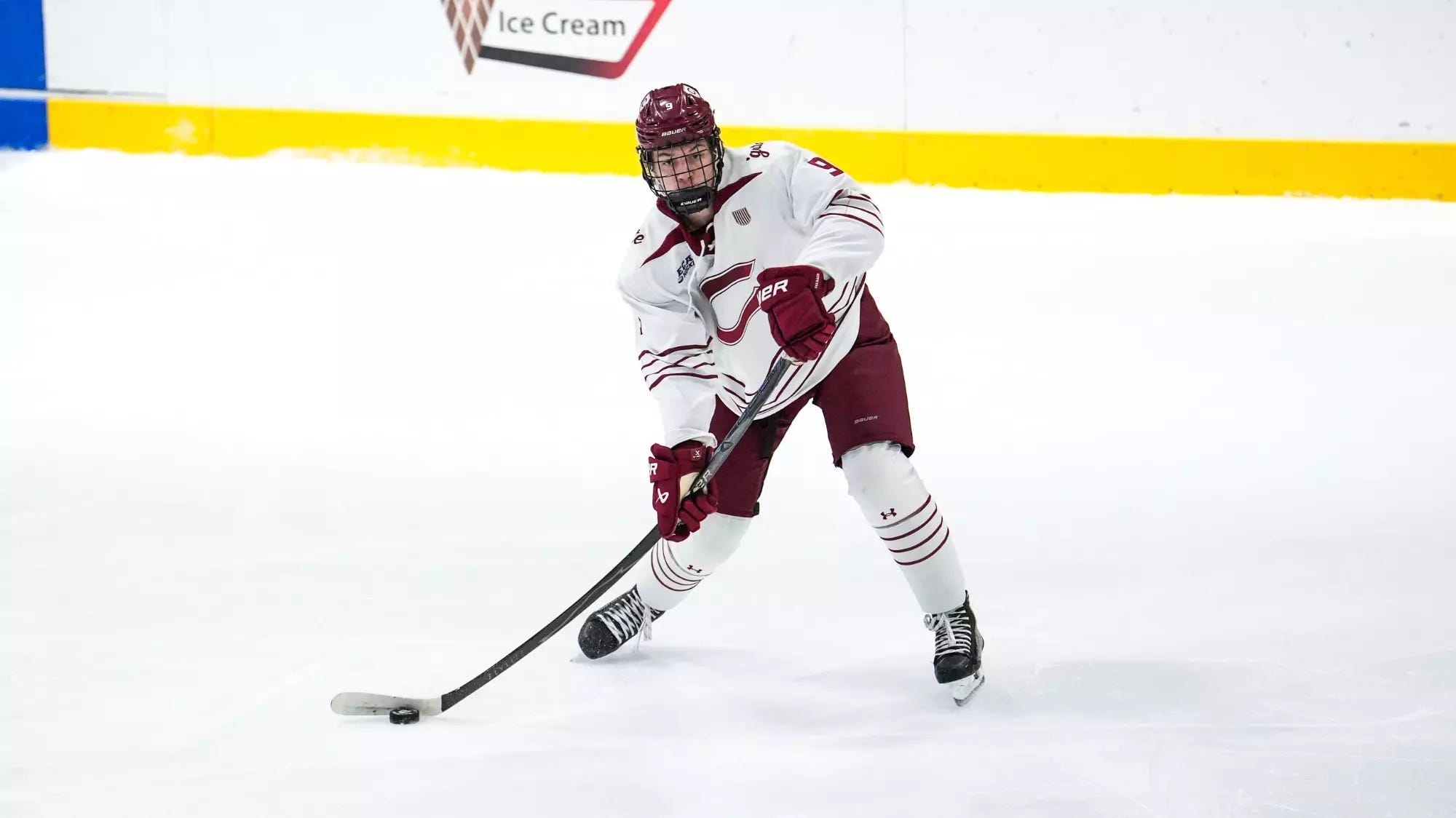
Nathan Larioza could contribute as a freshman too. He had nearly a point per game in the BCHL last year, but he left midway through the year to go to the USHL. He wasn’t nearly as productive in the USHL, but I think with Colgate’s lack of depth after those top 3, he could earn some minutes right away.
It all comes out to an average offensive projection. The lack of secondary scoring and depth at forward is the big issue, but if they can find a few breakouts there, Colgate could be sneaky good offensively.
Defense
Projected Defensive Rank: 8
Colgate will be weak again defensively, and they will likely be around the same ballpark as last season. Jacob Napier had the best defensive impacts on the team, and losing him definitely hurts. Funny enough, Neumeier’s loss actually helps the defense in the eyes of the model because his defensive impacts were terrible. He was a -28 in 37 games last year, and he handedly was losing his minutes. I don’t actually think he’s addition by subtraction, but the model doesn’t have a way to determine that. Luke Malboeuf had solid results in his depth minutes as a reliable, stay-at-home defenseman. It all evens out to be about the same defensively.
In net, there are major question marks. Reid Dyck returns, but he struggled as the starter last year with a 0.897 SV%. He saved -2.9 goals above expected on the season, which was 110th in the country. Colgate was supposed to bring in NHL draft pick Matthew Minchak, but he ended up going back to the OHL. They had to replace him with a walk-on type in net, so they also don’t have depth at the position and will be forced to rely on Dyck.
Overall, Colgate’s offense will have to be the strength of the team, but with the lack of depth up front, it will be tough in that department unless the blue line can really carry the load. The defense doesn’t look to have much hope barring a lot of improvement from the returning defensemen or Dyck performing much better than last year. Personally, I’d have Colgate a little lower than this with their question marks.
8. Princeton (Last Year: 4)
Princeton came out of nowhere last year to make a huge leap up the standings on the back of a veteran lineup with lots of development from those players. It was a great team, but nearly all the best players were seniors and have now graduated. While there is some returning talent, the drop off is quick and steep, and there does not appear to be enough talent to keep Princeton that high in the league.
Key Losses: F David Jacobs (36 points in 34 games), F Jaxson Ezman (26 points in 34 games), F Brendan Gorman (22 points in 34 games), D Tyler Rubin (16 points in 30 games), D Nick Marciano (11 points in 34 games)
Key Returners: F Kai Daniells (39 points in 34 games), F Jake Manfre (26 points in 34 games), D Kai Greaves (14 points in 34 games), G Arthur Smith (0.913 SV%)
Key Newcomers: F Jake Gudelj (WHL), F Shaan Kingwell (OHL)
Offense
Returning Offense Rank: 10
Recruiting
Overall
Total Rank: 12
Average Rank: 12
Freshmen
Total Rank: 12
Average Rank: 12
Transfer
Total Rank: N/A
Average Rank: N/A
Overall
Forwards Rank: 12
Defensemen Rank: 12
Total Offensive Rank: 12
Princeton lost nearly all of its talent with only the 10th most returning scoring in the league. They lose half of their top 6 with Jacobs, Ezman, and Gorman all gone after pretty good years. On the blue line, they lose 4 of their top 5 scoring defensemen. That’s a lot of key players to lose.
There are a few really good players returning. Kai Daniells was one of the most dangerous forwards in the league last season, and he will have to lead the offense again in his senior year. Jake Manfre broke out with 26 points, and he’s a very good player who will have to score a lot as well.
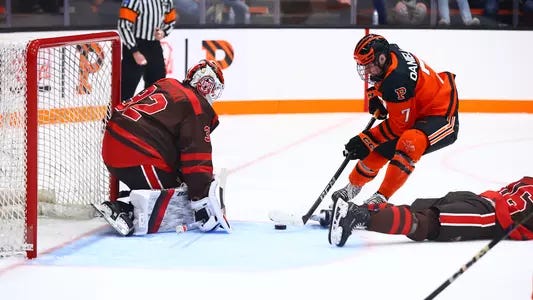
The issue is that the drop off after those two is absolutely massive. The next best forward is Julian Facchinelli who only had 10 points last season. Going from 26 points to 10 for the 2nd best forward to the 3rd best forward is very bad and shows a lack of scoring throughout the lineup. Fachinelli and Luc Pelletier, who had 11 points last season, will have to take huge steps forward in order for Princeton to have enough firepower offensively.
The only two incoming freshmen at forward are Jake Gudelj and Shaan Kingwell. Gudelj had a solid year in the WHL last year, but he projects as a bottom 6 type player to start. Kingwell had a similar year in the OHL and has the same projection. They will both have to play higher up in the lineup though. Kingwell has some potential in my opinion. He’s only 19, and Princeton is bringing him in a year early. He’ll have the opportunity to earn a key role right away though and fast-track his development.
On the blue line, Kai Greaves returns after posting excellent two way results last year in the top 4. He will be their top defenseman. After him though, there’s absolutely nothing offensively. Ian Devlin had 5 points last year, and Chris Reiniger had 4 points. None of the incoming freshmen defensemen have any track record of production in junior, even though there are 4 newcomers. Barring some offensive breakouts there, the defensemen can’t really be counted on offensively.
The offensive picture for Princeton is pretty destitute. Outside of the top 3 players, there’s practically no scoring projected, and it’s going to be tough for them. Even with a bunch of breakouts, I can’t see them getting anywhere close to the offense they had last year.
Defense
Projected Defensive Rank: 4
The defense, however, looks very good, and it will keep Princeton competitive this season. Even though they lose Rubin who had excellent defensive impacts, Marciano and Ma didn’t have great defensive impacts. Greaves was very good defensively and so was Ian Devlin. Devlin was pretty good in limited minutes last year, and he should play a larger role this season.
Even though the incoming freshmen don’t have much offense, they all profile as stay-at-home defensemen, which will presumably help as well even though that’s not factored into the model.
The cherry on top is returning goalie Arthur Smith. Smith finally broke out last season with a 0.913 SV%, and he returns for his senior year where he will be the clear #1 in net. They will need him to deliver a similar performance with the lack of run support they’ll have, and I expect he will. I’m pretty confident that with the returning defensemen, Smith, and Ben Syer’s defensive system that Princeton will remain very good defensively this year.
Overall, Princeton is going to be playing a lot of low event and low scoring games this year. They have the worst projected offense due to the lack of returning scoring and the league’s worst recruiting class. However, their defense should be pretty good, and I think that’ll stop them from slipping all the way to the bottom 4. Placing them 8th feels right.
9. RPI (Last Year: 9)
RPI enters year 2 of its rebuild under Eric Lang with an extremely young roster that will see lots of freshmen getting minutes right away. There was lots of roster turnover this offseason as the staff looked to bring in their guys. The model has them staying in 9th due to the youth, but I think they will finish a little higher than that after bringing in the top freshman class in the league per both Neutral Zone and Puck Preps.
Key Losses: F Luciano Wilson (22 points in 34 games), F Tyler Wallace (18 points in 35 games)
Key Returners: D Thomas Klassek (18 points in 34 games), F Filip Sitar (17 points in 35 games), F Rainers Rullers (16 points in 35 games), D Kazimier Sobieski (12 points in 35 games), G Nate Krawchuk (0.909 SV%)
Key Newcomers: D Grayson Burzynski (WHL), F Jordan Gavin (WHL), F Luke Goukler (USHL), D James Guo (OHL), F Caleb Hadland (WHL), F Harrison Lodewyk (WHL), G Ethan McCallum (WHL), D Ryan Michael (WHL), D Simon Motew (Maine), F Brendan Ross (Providence), F Leo Serlin (OHL), F Ben Yurchuk (Merrimack)
Offense
Returning Offense Rank: 11
Recruiting
Overall
Total Rank: 1
Average Rank: 7
Freshmen
Total Rank: 1
Average Rank: 7
Transfer
Total Rank: 2 (out of 9)
Average Rank: 6 (out of 9)
Overall
Forwards Rank: 10
Defensemen Rank: 7
Total Offensive Rank: 9
RPI only loses two key players at the top of the forward lineup. The reason they only have the 10th most returning scoring is because they largely turned over the bottom of the roster to make room for all the incoming freshmen. For the key returners at forward, Filip Sitar and Rainers Rullers are both young, two way centers who should take a step forward this year offensively, but right now, they only project to score at middle 6 rates. RPI will need more improvement than that.
The high quality recruiting class will likely fill in most of the forward lineup. The model has these recruits ranked lower than Neutral Zone or Puck Preps because the vast majority of the recruiting class is from the WHL, and the production of WHL players last year didn’t translate as well as the other CHL leagues. As a result, I think that a lot of these freshmen are likely underrated by the model, and I think they will perform more in-line with the Neutral Zone ratings, which are based on in-person viewings. The recruiting would also have rated even better if Shane Smith and Josh Evaschesen didn’t defect at the last minute in August.
For those incoming forwards, Brendan Ross and Ben Yurchuk come in from the portal after not getting much ice time at Hockey East schools. Ross had a good freshman year at Alaska, and he was one of the top players in the AJHL before college. He should rebound and play a much bigger role for RPI than at Providence where he struggled to crack the lineup. Yurchuk was good in the USHL prior to going to Merrimack and should also see a bigger role for RPI.
The freshmen all look solid as well. Jordan Gavin is the former #2 overall pick in the WHL draft, and he comes to RPI after putting up 58 points last season. He’s in line for the top 6 right away. Luke Goukler had 31 points in the USHL last year, and he should make an immediate impact on the 3rd or 4th line. Caleb Hadland was another former first round WHL pick, and he had 44 points last season and will be an immediate contributor. Harrison Lodewyk should contribute in the bottom 6 after having 40 points in the WHL. Lastly, Leo Serlin had 41 points in the OHL last year, and he also looks like he can contribute in the bottom 6.
The issue with RPI’s forward group is that there’s a ton of depth, but there is pretty much no high end talent right now. The returners I mentioned plus Jagger Tapper, Ian Scherzer and Matthew Buckley all look like middle 6 type players. None of the freshmen really project to be studs right away (Evaschesen and Smith would have really helped here), so even though there’s a lot of quantity there, the quality isn’t high enough.
The blue looks better with some good puck movers. All-ECAC Rookie team defenseman Thomas Klassek returns and should build upon that season at the top of the lineup. Kazimier Sobieski also returns and has some good offensive abilities.
The recruiting class also looks excellent on the defensive side and will add much needed support for those two. Starting with Grayson Burzynski, he was one of the top defensemen in the WHL last season with 58 points in 59 games and will immediately play a big role in the top 4. He is one of the top incoming freshmen in the entire league. James Guo had a very good year in the OHL and also looks capable of playing top 4 minutes right off the bat. Simon Motew barely played last season at Maine, but he had a good track record of play in the OHL and USports prior to Maine. He should provide some steadiness on the 3rd pairing. Lastly, Ryan Michael had 33 points in the WHL last season, and he is also capable of contributing offensively.
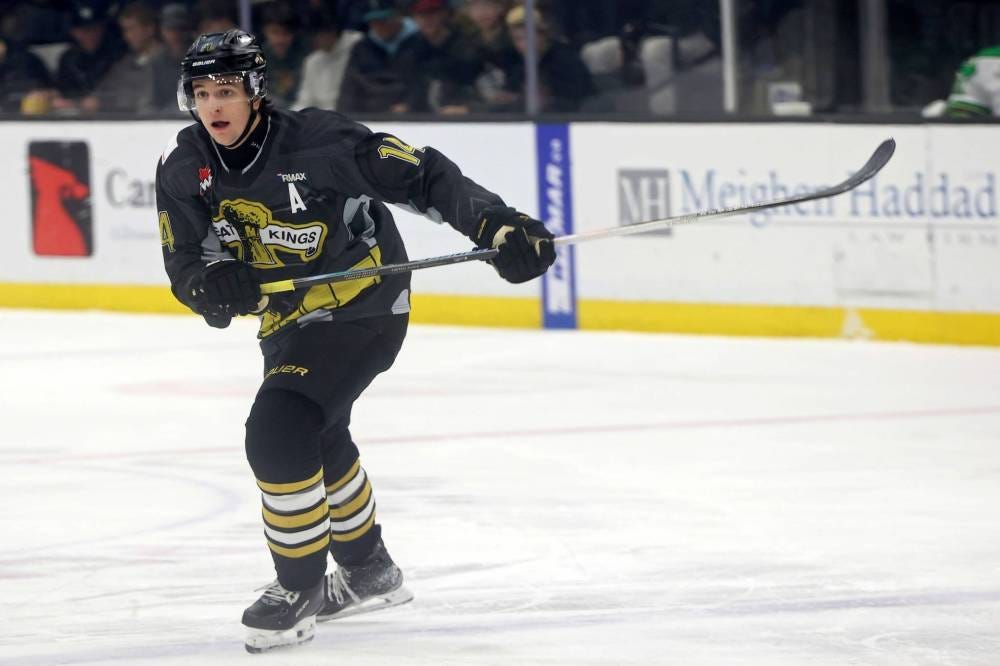
Overall, RPI is just a young team with a lot of talent that looks kind of similar to Clarkson last year in some ways. They will have a lot of freshmen playing key roles right away, and they have a ton of offensive depth that they can roll out. If some of their younger players can breakout or any of the freshmen take the ice time and produce a lot, RPI could do some damage.
Defense
Projected Defensive Rank: 9
Since RPI turned over nearly its entire defense corps, they rate on the lower end here too. RPI actually has the least returning defensive impacts in the league, which is what keeps their projection low. Sobieski struggled defensively last season in #1 minutes that he probably was not quite ready for yet. Klassek faired a little better but wasn’t anything to write home about defensively either.
The defensive decline projected from all that talent gets balanced out by the goaltending room, which projects to be quite strong. Nate Krawchuk returns after a good freshman year with a 0.909 SV%, and he finished the season playing absolutely lights out. He projects to be the starter in net once again.
However, he will be pushed by Ethan McCallum who the model likes a lot. McCallum had a 0.907 SV% in the WHL last season, which was 6th in the league. He should be a very good college goalie, and he is capable of beating out Krawchuk although he will probably start out as the #2. If he is the backup, he’s a luxury to have as the #2. This is definitely one of the better goaltending rooms in the league.
Overall, I think RPI finishes a bit higher than this. I already mentioned how I think the model is a little low on the recruiting class due to the WHL translation from last season. I also think it’s a bit low on the defensive side. Even though RPI lost the most from their back end among all teams in the league, the reason for that was they were turning over their roster, and the defensemen they bring in are better than the ones who left. With the youth on the roster, I don’t think they’ll be in the top 6, but I foresee a similar season as Clarkson last year. The talented and young roster will probably be inconsistent with ups and downs, but they will be playing their best hockey at the end of the year and a tough out in the playoffs despite being a lower seed.
10. Yale (Last Year: 10)
Yale enters year 1 of the Jeff Hamilton era with some young offensive talent but a pretty bad defense, which is what keeps their projection low. I don’t think it’s out of the question that Yale outperforms this if they can find good goaltending and better defense, but it’ll be tough to do that under an entirely new staff.
Key Losses: F David Chen (24 points in 31 games), F Tyler Wallace (18 points in 35 games)
Key Returners: F Ronan O’Donnell (23 points in 28 games), F Donovan Frias (21 points in 31 games), F Micah Berger (18 points in 31 games), F Iisai Pesonen (13 points in 28 games), D Rhys Bentham (11 points in 31 games)
Key Newcomers: F Alex Assadourian (OHL), F Kyle O’Leary (USHL)
Offense
Returning Offense Rank: 4
Recruiting
Overall
Total Rank: 11
Average Rank: 11
Freshmen
Total Rank: 11
Average Rank: 11
Transfer
Total Rank: N/A
Average Rank: N/A
Overall
Forwards Rank: 8
Defensemen Rank: 9
Total Offensive Rank: 8
Yale only loses 2 out of its top 15 scorers and returns 84.3% of its point production, which is great and bodes well for its offense this year. Leading scorer David Chen did graduate, but the rest of the lineup returns.
Ronan O’Donnell had 23 points in 28 games last season, and he projects to be close to a point per game this season. He’s likely the best forward at the top of their lineup. Donovan Frias and Micah Berger are both good forwards too, and the three of them should give Yale a pretty dynamic top line.
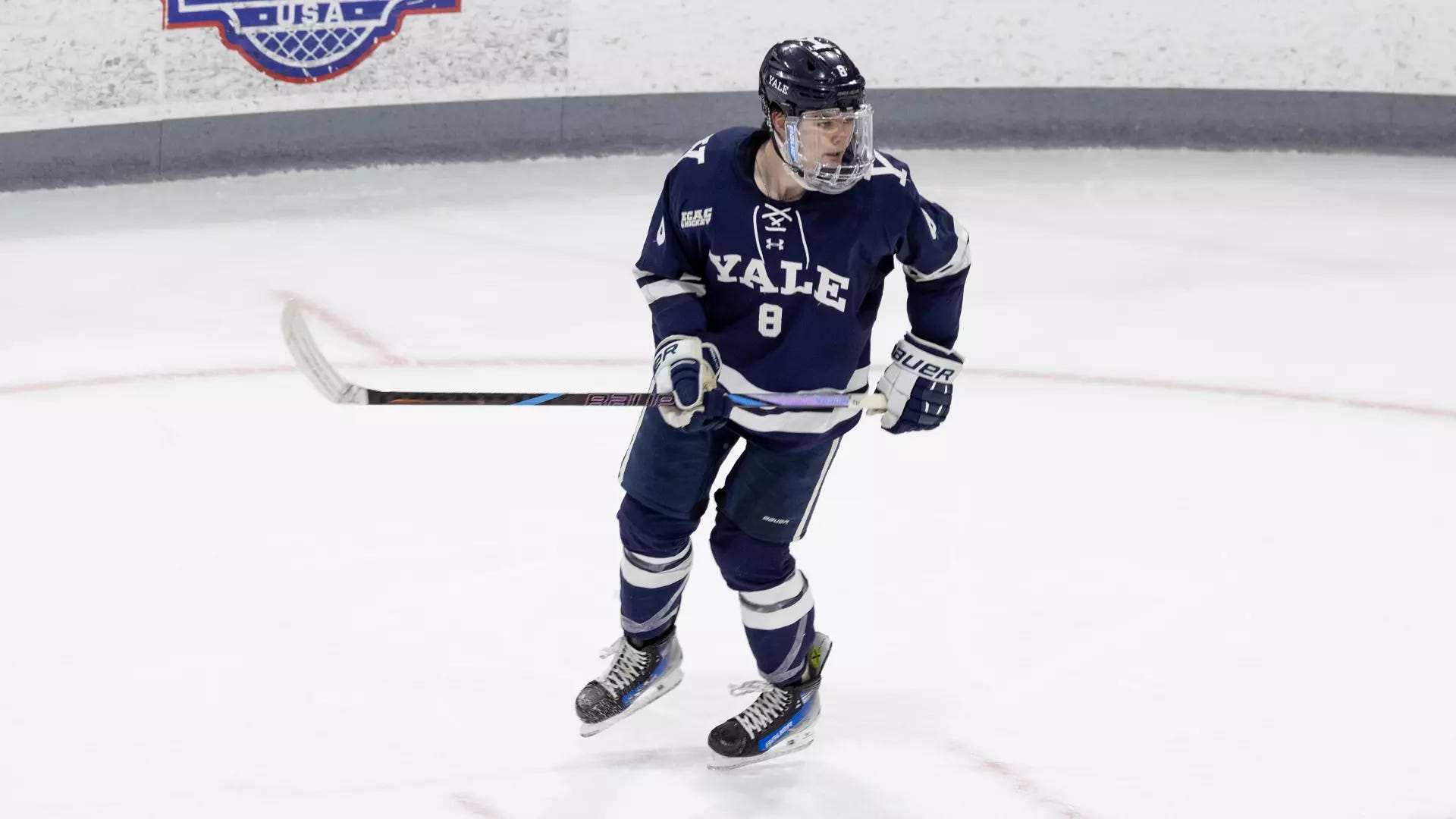
After those three though, Yale will be relying on a bunch of players to take steps forward and provide more secondary scoring. David Andreychuk, Iisai Pesonen, James Shannon, Zach Wagnon, and Will Richter all had between 10 and 14 points last season. The model does project progression now, but they will have to outpace that projected improvement to give Yale enough secondary scoring.
There’s only 2 freshmen expected to make immediate impacts, and they both have bottom 6 projections. Alex Assadourian had a solid year in the OHL, but he switched to the USHL mid-season and really struggled. Kyle O’Leary played the full year in the USHL and had a solid year with 33 points. With all the returning forwards, I don’t expect either will be super high in the lineup.
On the blue line, Rhys Bentham returns as the top defenseman after 11 points in 31 games last year. Hughie Hooker had 9 points in only 26 games, and Owen Forester had 8 points in only 24 games. Both of them will have to up their games in bigger roles. All 3 need to produce more as the top defensemen in the lineup. Dylan Hunt could also take a step forward after 8 points in 31 games as a freshman.
Despite all the returners, Yale still is about average in their offensive projection. The lack of secondary scoring is the biggest factor, and the players I listed will all need to step up. The other main issue is there are no real high scorers in defense corps despite having some solid players back there. If the returning players can develop on that end too, Yale would be in good shape. Those are two question marks though.
Defense
Projected Defensive Rank: 11
Despite the offense having a decent outlook, the projected defensive performance keeps Yale pretty low in the projections. Yale was awful defensively last season, allowing 3.71 goals per game, and they don’t project to be much better this year.
Only Owen Forester had a positive defensive impact on the blue line last year. Most of the returners were in the negatives in +/-, and I’m not sure how much improvement can be counted on there. If all these returning players can be more reliable defensively, which is a big if, Yale is still starting from such a low spot on defense that it wouldn’t rise enough to make them a competitive team.
The bigger issue is in net. The top two goalies are Noah Pak and Jack Stark, and neither can be counted on to be the #1. Starting with Pak, he has the higher model projection because he wasn’t totally awful last year, but he still only had a 0.902 SV%. His freshman year, he had a 0.872 SV%. Stark was great as a freshman with a 0.919 SV%, but he has been awful since that year. Last year, he had a 0.871 SV% and was among the worst goaltenders in the country. This is one of the worst goaltending rooms in the league, and the defensive projection reflects that.
Overall, Yale is probably one of the most likely teams to outperform their projection due to the sheer number of returners. If their players can take big steps forward to improve their offensive depth and defensive capabilities, they can compete for home ice. It would need to be big steps though, and I’m just not sure they have that in them.
11. Brown (Last Year: 12)
Another Ivy with a new coach at the helm, Brown lost all of their best players this offseason during the coaching change. Tom Upton arrives in Providence looking to rebuild Brown the same way Reid Cashman has rebuilt Dartmouth. They don’t have the talent to be competitive this year, but the model projects the defense to be good enough to keep them out of the basement.
Key Losses: F Ivan Zadvernyuk (22 points in 30 games), F Ryan St. Louis (15 points in 30 games), D Matthew Desiderio (12 points in 31 games)
Key Returners: F Ben Poitras (18 points in 31 games), F Andrew King (11 points in 20 games), D Ethan Mistry (6 points in 31 games)
Key Newcomers: F Matteo Danis (WHL), F Cullen Emery (USHL), F Griffin Erdman (Northeastern), D Marco Senerchia (USHL), G Devin Shakar (USHL)
Offense
Returning Offense Rank: 12
Recruiting
Overall
Total Rank: 9
Average Rank: 10
Freshmen
Total Rank: 9
Average Rank: 10
Transfer
Total Rank: 6 (out of 9)
Average Rank: 8 (out of 9)
Overall
Forwards Rank: 11
Defensemen Rank: 11
Total Offensive Rank: 11
Brown’s lack of talent jumps out right away when the top projected forward only had 18 points last year. While Poitras is a good player who excites with his speed and skill, it is worrisome when a player of that level is the top forward on the roster. Behind him, Andrew King returns after showing some productivity in a limited role last year. It might have been an aberration given his lack of scoring in junior, but hopefully for Brown’s sake, it was not. Brian Nicholas is another key returner. As a freshman, he had 25 points in 28 games, but he really struggled last year with only 13 points in 31 games. Brown really needs a bounce back from him.
Brown does have some good incoming players who will help out their scoring. Griffin Erdman has the best projection after scoring 15 points in limited ice time with Northeastern last season. With a much larger role at Brown, he should be pretty good in the top 6. Matteo Danis had nearly a point per game in the WHL, and while he projects as more of a middle 6 type to start, he will likely play in Brown’s top 6. Lastly, Cullen Emery had a good year in the USHL and is a well-rounded forward who should make an impact on the 3rd line.
On the blue line, there’s really no offense to speak of after Desiderio and Pineau transferred out. The top offensive projection among all the defensemen on the roster belongs to Marco Senerchia who had a solid year in the USHL (but not anything to write home about), and he’s projected for only 8 points. Similar to the forwards, if your top offensive defenseman is only projected for 8 points, it’s going to be a difficult time scoring. The rest of them are either stay-at-home types or just don’t really have a whole lot of skill.
There’s just overall a general lack of talent across the roster, and it’s tough to see Brown scoring a lot. There’s some players with potential at the top of the forward lineup. Upton will have to develop those guys as his foundation and then add a lot of talent to the roster in the coming years as he begins his rebuild.
Defense
Projected Defensive Rank: 10
Brown has some big question marks defensively as well. Ironically, the model has them improving on that side after losing Desiderio and Pineau. The two of them had a -20 and -18 rating, respectively, both the two worst on the team. Since those defensive impacts were pretty horrendous, the model views it as addition by subtraction. Even though the case was likely just that they were out of their depth with the quantity and difficulty of their minutes, those are still really bad results.
Ethan Mistry returns as the top defender on the roster. He has consistently posted good defensive results at Brown despite contributing little offensively. This season, he should continue to do well there for Brown, and I expect he will also take on a bigger load with Desiderio and Pineau gone.
The goaltending is another big question mark for Brown. Freddie Halyk returns after losing the starting role last year to Tyler Shea. He struggled a lot with a 0.881 SV%, but prior to Brown, he had some decent results at Denver. Can he get back to that level? We’ll have to see. The model doesn’t really believe in him after last year.
Brown also brought in Eli Pulver from the transfer portal after he really struggled at Wisconsin last season. He had a 0.867 SV% in 12 games there, but before going to college, he was excellent in the BCHL. He had a 0.923 SV% in his BCHL career with nearly 100 games played. There’s clearly some potential there although skepticism is certainly warranted.
Lastly, the goalie with the highest model projection is actually incoming freshman Devin Shakar. While his projection isn’t very good, he was okay in the USHL last year, especially given his situation. He had a 0.888 SV% with the Omaha Lancers, one of the worst teams in the league. They had an incredibly leaky defense, allowing more than 34 shots against per game. All things considered, he didn’t do too bad, but he still projects more as a reliable backup than a starting level goalie.
Overall, Brown’s talent will hold them back, but their defense should be enough to keep them out of the basement. If the blue line can improve in terms of how much they give up, and Brown can find an answer in net between those 3 goalies, they can outperform this ranking. I still can’t see them getting higher than 9th though at the absolute highest.
12. St. Lawrence (Last Year: 11)
St. Lawrence has a lot of young returning talent to build off of after another year in the bottom 4. However, the defense was the worst in the country last season, and they are running back the same goaltending group and most of the same defense corps. The defense is again projected to be very bad as a result and is the reason they’re projected for last.
Key Losses: F Tyler Cristall (31 points in 34 games), F Rasmus Svartstrom (24 points in 34 games)
Key Returners: F Cayden Casey (24 points in 35 games), F Cooper Pierson (20 points in 34 games), F Filip Juricek (18 points in 35 games), F Sam LeDrew (18 points in 32 games), F Isaac Tremblay (16 points in 33 games)
Key Newcomers: F James Fisher (Northeastern), F Ihnat Pazii (OHL), F Luke Posthumus (OHL), F Jake Rozzi (Ohio State), F Owen Tylec (USHL)
Offense
Returning Offense Rank: 9
Recruiting
Overall
Total Rank: 8
Average Rank: 8
Freshmen
Total Rank: 10
Average Rank: 9
Transfer
Total Rank: 5 (out of 9)
Average Rank: 7 (out of 9)
Overall
Forwards Rank: 7
Defensemen Rank: 10
Total Offensive Rank: 10
Despite losing Tyler Cristall and Rasmus Svartstrom, St. Lawrence actually has a pretty solid forward group due to tons of players returning from last year’s team. They return 8 out of the top 10 scorers and 12 out of the top 15.
Cayden Casey returns as the top line center after a 24 point season last year. Cooper Pierson, Filip Juricek, and Sam LeDrew all return for their sophomore years. They all had very good freshman years with between 18 and 20 points. Isaac Tremblay had 16 points last year and should play a role in the middle 6. Those players all project to be pretty solid. After those players, there’s also a bunch of depth players returning too.
Those players make up the core of the lineup, but there’s a few good newcomers that will play key roles too. Jake Rozzi had 12 points at Ohio State as a freshman before fighting injuries last year and only getting 10 games. He should have an expanded role at SLU, and he has a good track record going back to the USHL. I think he will end up playing in their top 6. Luke Posthumus comes in after a very good year in the OHL with 57 points. He projects to make an immediate impact in the middle 6. Lastly, Ihnat Pazii and James Fisher both have bottom 6 projections, which helps add to the forward depth of the group. Add it all up, and SLU has a pretty decent forward group with some good top 6 players and some depth too.
The blue line is where their offensive projection gets hurt though. They return their entire top 4, but none of those players surpassed 8 points. The good thing is that 3 of them were freshmen, so if those players can take big leaps forward, St. Lawrence’s offense could be getting underrated by the model. None of the incoming defensemen have good offensive projections either. The best one is William-Charles Bishop who transferred in from Clarkson. With an increased role, he could provide more offense than he did at Clarkson, but he’s right in line with the others.
Defense
Projected Defensive Rank: 12
The defense is again expected to be one of the worst in the country, which is why SLU falls below Brown in the projections. While they do return the entire top 4, they lose Babbage and Bandu whose defensive impacts were better than the rest of the team (even though they still weren’t good). That hurts them since the top 4 all had very poor defensive impacts with 3 of them at -15 or worse on the season.
St. Lawrence is projected to have weak goaltending too. Cameron Smith returns after he had a 0.903 SV% last year and took hold of the starting job. Even factoring in the defensive struggles though, that’s still a bad mark for a starter. They should improve simply by starting him in the majority of games because Mason Kucenski was one of the worst goalies in the country last year. Smith isn’t good enough though for that to drastically improve their defense. They will need the defensemen to take big leaps in terms of their ability to prevent chances.
Overall, St. Lawrence’s offense will probably be below average, but it has the potential to surprise if the defensemen take larger steps forward. Since the team was so young last year, they also could all improve a lot more across the board than the model is giving credit for. The defense will have to improve drastically in order to compete for home ice though. I think the model is a little low on SLU here given how young they were last year and how their offensive ceiling is definitely higher than Brown’s. I feel like they have a wider range than the other teams down this low in the standings because they have more offensive talent and depth. It’ll be interesting to see where they end up.
Final Model Rankings
Quinnipiac
Dartmouth
Cornell
Union
Clarkson
Harvard
Colgate
Princeton
RPI
Yale
Brown
St. Lawrence
My Rankings
Quinnipiac
Dartmouth
Cornell
Clarkson
Harvard
Union
RPI
Princeton
Colgate
Yale
St. Lawrence
Brown
Model Tiers
Quinnipiac
————————-
Dartmouth
Cornell
————————-
Union
Clarkson
Harvard
————————-
Colgate
Princeton
RPI
————————-
Yale
Brown
St. Lawrence
All-League Predictions
1st Team
Jr F Hayden Stavroff, Dartmouth
Sr F Kai Daniells, Princeton
So F Ethan Wyttenbach, Quinnipiac
Sr D Tyler Dunbar, Union
So D Xavier Veilleux, Cornell
Sr G Emmett Croteau, Dartmouth
2nd Team
So F Antonin Verreault, Quinnipiac
Jr F Hank Cleaves, Dartmouth
Jr F Chris Pelosi, Quinnipiac
Jr D Isaiah Norlin, Colgate
Sr D CJ Foley, Dartmouth
Jr G Rorke Applebee, Quinnipiac
3rd Team
So F Caton Ryan, Cornell
Sr F Ryan Walsh, Cornell
Jr F Max Nagel, Colgate
Sr D Matthew Morden, Harvard
Jr D Elliot Groenewold, Quinnipiac
Sr G Arthur Smith, Princeton
All-Rookie Team
F Drew Stewart, Dartmouth
F Justin Graf, Harvard
F Luke Garry, Union
D Alex Huang, Harvard
D Grayson Burzynski, RPI
G Rudy Guimond, Harvard
Awards
Player of the Year: So F Ethan Wyttenbach, Quinnipiac
Goalie of the Year: Sr G Emmett Croteau, Dartmouth
Rookie of the Year: Fr D Alex Huang, Harvard
Thanks for reading! I’m excited for the season to begin this week, and we’ll be able to start seeing how the ECAC does in non-conference play!